Attacking the End Line Crossing Game
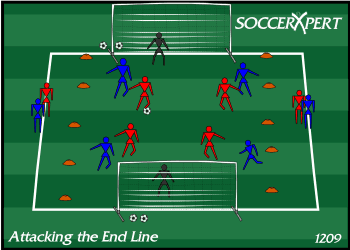
Two teams play 4v4 in the middle and 1v1 out in the channels — and the only way to score is off a ball served in from a flank.
Isolating the flank players is how they learn to attack the end line and serve the ball in front of the goal — and how everyone else learns to run onto it.
20 min tonight · Two teams of 4, plus channel players and 2 keepers
- Ages 9+
- Two teams of 4, plus channel players and 2 keepers
- 20 min as the drill is written
- Cones, pinnies, balls, 2 full-size goals
Grab Cones — 4 or 5 per side for the channels — plus pinnies, balls, and your two goals.
Build On half a field, move one goal to the midfield line facing the end-line goal, and use the cones to mark a 10-yard-wide channel along each touchline.
Place Two teams of 4 in the middle, each team's channel player out wide, and a keeper in both nets — one team starts with the ball, the rest of the balls behind the goal.
- 1
Organize the players
Put a team of four from each side in the middle area, send the channel players wide, and put a keeper in both nets. One team starts with the ball; spare balls wait behind the goal.
“Fours in the middle, wide players in your channels, keepers in. One rule makes this game — goals only come from out wide.”
- 2
Show the jobs
Walk the scoring path — the ball must be served from a channel to score. When the ball goes into a channel, the channel players play 1v1 until one breaks into the offensive side of the channel — and at that point the defender allows the cross. Meanwhile the four in the middle make their runs — near post, far post, trail, and support.
“Wide players — beat your defender into the attacking half of your channel, then serve it. Middle — near post, far post, trail, support. Fill them every time.”
- 3
Play
Let it run and coach the service from the flanks — when to serve on the ground, when to knock it back, and when to drive it hard — and make sure the attackers are making proper runs every time the ball goes wide.
“Ball's wide — runs! Near, far, trail! Crosser — pick your serve!”
Look for The serve matched to the moment — on the ground, knocked back, or driven hard — arriving with the runs already moving.
- 4
Switch and repeat
Rotate the channel players so everyone gets flank time. In later rounds, bring wall passes, takeovers, and overlaps into the game, or increase or decrease the number of players in the middle.
“Rotate — new wide players! And I want to see an overlap this round.”
If the ball never finds the channels, freeze it and ask — where does a goal have to come from? Let them say it, then play on.
Go deeper · 2 notes
Why it works
The score-only-from-a-serve rule makes the flanks the whole game — the channels isolate a real 1v1 to the end line, the defender letting the cross go once beaten keeps the serves coming, and the middle four get cross after cross to run onto.
What they learn
Attacking the end line and serving crosses from the flanks — when to serve on the ground, when to knock back, and when to drive hard — with near-post, far-post, trail, and supporting runs in the middle.
Where does this come from?
SoccerXpert — their published drill library.
A published drill library. Useful and widely used, but not a governing body — so it fills gaps rather than leading.