When to Dribble
Two grids, twelve yards apart — after your pass count, one attacker picks the moment and dribbles to the far grid at match speed, where wide teammates are waiting.
Recognizing when to make the run is half the skill — being comfortable making it at match speed is the other half, and this drill works both.
Starting at Core — your team is set to mixed.
20 min tonight · 5v2 and 4v2, one per grid
- Ages 9+
- 5v2 and 4v2, one per grid
- 20 min as the drill is written
- Cones, pinnies, balls
Grab Cones, pinnies to split attackers from defenders, and balls.
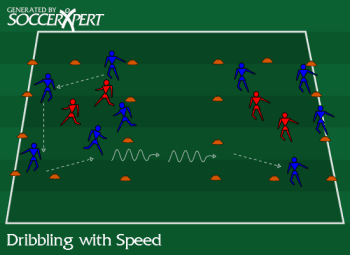
Build Build two 20-by-20 grids about 12 yards apart.
Place Five attackers and two defenders in one grid, four attackers and two defenders in the other — the 5v2 grid starts with the ball.
- 1
Organize the players
Set up the two grids — five attackers and two defenders in one, four attackers and two defenders in the other. The 5v2 grid starts the play.
“Five and two here, four and two there. Ball starts on the crowded side.”
- 2
Show the jobs
Walk the sequence — the attackers make your number of passes; after that, one of them chooses a good opportunity and advances to the other grid on the dribble at match speed; entering the new grid, that player makes a good passing decision to keep the game fluid and away from the defenders; meanwhile the supporting players in the receiving grid open it up, getting wide and spreading out as much as possible.
“Hit the pass count, then somebody goes — full speed, ball on your foot. Far grid, get wide and give them somewhere to land.”
- 3
Play
Keep the pattern turning grid to grid. Coach the whole decision chain — carrying the ball at speed, making the right decision on when to dribble across, and making good decisions on entering the opposite grid so possession holds.
“Is it on? Then go — carry it! Land it with a good pass!”
Look for The recognition — a player choosing the right moment to leave, then entering the new grid with a good passing decision instead of just arriving.
- 4
Switch and repeat
Keep the crossings coming so every attacker gets runs. To sharpen it, restrict the number of touches per player inside the grids — or allow one defender to track the dribbler and enter the opposing grid.
“New wrinkle — a defender can chase the runner now. Make your run mean it!”
If nobody ever advances, freeze it the moment a good opportunity shows and ask what they see — let them name it, then play on.
Go deeper · 2 notes
Why it works
The pass count builds a normal rhythm, so the dribble across is a real decision — recognize the opportunity, leave at match speed, and arrive still in control — and the far grid spreading wide makes the run land in space instead of traffic.
What they learn
Recognizing when to dribble, carrying the ball at speed, making good decisions entering the opposite grid to keep possession, and opening up wide to give the advancing attacker space and options.
Where does this come from?
SoccerXpert — their published drill library.
A published drill library. Useful and widely used, but not a governing body — so it fills gaps rather than leading.