Speed of Play Passing Game
In grids of four, three attackers keep the ball away from one tagger — hold it for a count of 30 elephants and score a point; get tagged on the ball and you take the pinnie.
Speed of play, decision making, and passing accuracy under pressure — the defender can only tag the player in possession, so the ball has to keep moving.
Starting at Core — your team is set to mixed.
15 min tonight · Groups of 4 (3v1 per grid)
- Ages 9+
- Groups of 4 (3v1 per grid)
- 15 min as the drill is written
- Cones, pinnies, balls
Grab Cones, pinnies, and two balls for each group of four.
Build Build a 15-by-15 grid for every four players — smaller or larger depending on their skill and age.
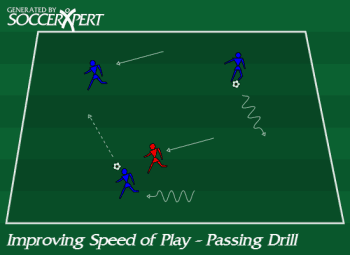
Place Three attackers and one defender in each grid, the grid's two balls with the group, the defender holding the alternate pinnie in their hands.
- 1
Organize the players
Make groups of four and send each to its own grid — three attackers and one defender. The defender carries the alternate pinnie in their hands the whole time they defend.
“Three keep it, one chases. Defender — that pinnie stays in your hands until you tag somebody.”
- 2
Show the jobs
Walk the rules — attackers can position themselves anywhere in the grid and should keep moving to create support for the teammate on the ball; the defender is not trying to win the ball, only to touch an attacker while that player is in possession; a successful tag hands the pinnie to that attacker and they switch roles; and attackers who hold possession for a count of 30 elephants earn a point — shorten the count for younger or newer players.
“You can't be tagged without the ball — so move it, and move yourself. Thirty elephants without a tag is a point.”
- 3
Play
Run the grids and coach the movement — good supporting movement and angles, thinking a step ahead of the defender, knowing where the next ball is coming from and where it's going, and passing decisions made with good pace. Introduce combination play into the mix as they get comfortable.
“Think one pass ahead — where's it coming from, where's it going?”
Look for The player off the ball — attackers moving into supporting angles before their teammate needs them.
- 4
Switch and repeat
Keep the pinnie changing hands and the points counting. For a harder round, have the defender actually tackle for the ball — roles switch when the ball is won — or change the attackers' touch limit.
“New round — now the defender wants the ball, not the tag. Keep your count going!”
If a point never comes, cut the count down — fewer elephants until holding the ball that long is possible — then build it back up.
Go deeper · 2 notes
Why it works
The defender can't win the ball — only tag the player holding it — so safety lives in moving the ball and moving yourself, which is exactly the speed of play, decision making, and passing under pressure the drill is built to improve.
What they learn
Speed of play — supporting movement and angles, thinking a step ahead of the defender, knowing where the next ball comes from and goes, and passing with good pace, with combination play mixed in.
Where does this come from?
SoccerXpert — their published drill library.
A published drill library. Useful and widely used, but not a governing body — so it fills gaps rather than leading.