Finding the Target Player
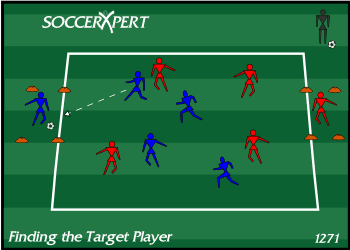
Two teams keep possession in a big grid, hunting the moment to drop a flighted ball into their target player's box — control it in there for a point, and the passer becomes the target.
Midfielders and defenders learn to get their heads up and look up the field — finding the target player and playing them early.
Starting at Core — your team is set to mixed.
20 min tonight · Two even teams
- Ages 12+
- Two even teams
- 20 min as the drill is written
- Cones, pinnies, balls
Grab Cones, alternate jerseys for the two teams, and balls.
Build Build a large grid about 40 by 40 yards — sized to your numbers and their age — then have each team build a 10-by-10 box on its attacking end, where the diagram shows.
Place Two even teams spread through the big grid, one target player from each team standing inside their box.
- 1
Organize the players
Make two even teams in alternate jerseys and send one target player from each team into its 10-by-10 box on the attacking end.
“Two teams! Pick your target player — they live in the little box on the end you're attacking.”
- 2
Show the jobs
Walk the scoring — keep possession from the other team, and look up early for the chance to play a flighted ball into your target player. If the target controls it inside the box, that's a point — and the passer swaps in as the new target.
“Keep the ball, but keep looking long — a ball your target controls in the box is a point. Hit it, and you become the target.”
- 3
Play
Let it run and hold the line between playing early and playing kickball — heads up quickly, the target played early, and every long ball placed on purpose rather than hopeful.
“Heads up the second you get it — is the target on? Then place it, don't blast it!”
Look for The placed pass — a long ball aimed at the target on purpose, never an accidental clearance dressed up as one.
- 4
Switch and repeat
The game rotates itself — every ball controlled in the box makes the passer the new target. When they're ready, grow the target's box and put a defender in with them, somewhat passive at first.
“New wrinkle — a defender in the box now. Same job: find your target early.”
If it turns into kickball, freeze it and ask — was that ball placed, or just hit? Let a player say the difference out loud, then play on.
Go deeper · 2 notes
Why it works
The point only comes when the ball is controlled inside the box, so a hopeful boot earns nothing — the game quietly demands heads up early, a deliberate look up the field, and a flighted ball placed with purpose.
What they learn
Getting heads up quickly to find the target player, playing the target early, and the difference between a purposely placed long ball and kickball.
Where does this come from?
SoccerXpert — their published drill library.
A published drill library. Useful and widely used, but not a governing body — so it fills gaps rather than leading.