Dribbling to Beat a Defender
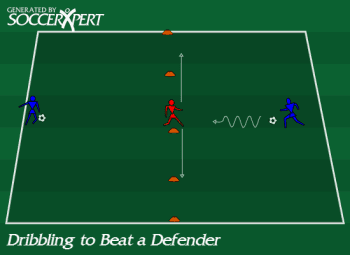
One defender slides side to side along the halfway cones; attackers dribble at them under control, make them commit, cut past and accelerate away — lose your ball and you take the line.
Young players learn when and where to dribble — and how to beat a defender on the dribble by unbalancing them while approaching unchallenged.
10 min tonight · Groups of 3, 2 balls each
- Ages 4–12
- Groups of 3, 2 balls each
- 10 min as the drill is written
- Cones, pinnies, balls
Grab Cones for the grid and the halfway line, and two balls for every group of three.
Build Build a 20-by-10 grid and mark the halfway with a line of cones about 5 yards apart.
Place The defender takes the middle line; the other two players each take a ball and start as the diagram shows.
- 1
Organize the players
Split into groups of three with two balls. Put one defender on the middle cone line; the other two players start with the balls as the diagram shows.
“Threes! One of you holds the middle line — you two, grab the balls.”
- 2
Show the jobs
Walk the restriction — the defender may only move side to side along the middle line, trying to stop the dribbler. The attacker approaches under control, makes the move only after the defender commits, and accelerates to the other side of the grid.
“Defender, you're on a rail — side to side only. Attacker, come in slow and smooth, wait for the lean, then go!”
- 3
Play
Run the attacks and hold the standard — a controlled approach, a fake the defender believes, a real change of direction, and acceleration all the way to the end line once past.
“Slow to the line, quick past it — sell your move!”
Look for The commit — attackers holding their move until the defender actually leans, then cutting the other way.
- 4
Switch and repeat
The game runs the switch — when the defender wins a ball, they swap jobs with the attacker who lost it. Keep the attacks rolling.
“Defender won it? Trade jobs — you're on the line now.”
If nobody ever gets past, pull the grid a few steps wider while they play — a side-to-side defender can't cover the extra width — then bring it back in as the moves improve.
Go deeper · 2 notes
Why it works
The rail rule lets the attacker approach unchallenged and work on the real skill — unbalancing the defender: come in under control, wait for the commit, change direction, and accelerate through the space the lean just opened.
What they learn
When and where to dribble and how to beat a defender — the controlled approach, selling the fake, changing direction, and accelerating to the end line once past.
Where does this come from?
SoccerXpert — their published drill library.
A published drill library. Useful and widely used, but not a governing body — so it fills gaps rather than leading.