Dribbling at the Cone
In threes, each player dribbles at a middle cone, sells a fake, cuts past it and bursts to the far side — then lays the ball off so a teammate attacks the cone right back.
Young players learn to dribble without opposition — and it's a fabulous place to introduce the fakes and feints that win an edge on a real defender.
Starting at Core — your team is set to mixed.
10 min tonight · Groups of 3, one grid each
- Ages 4–12
- Groups of 3, one grid each
- 10 min as the drill is written
- Cones, balls
Grab Cones for the grids, a 9-inch cone for each middle, and one ball per group of three.
Build Build a 20-by-10 grid for every three players with a 9-inch cone in the middle — add more 9-inch cones in the area as your numbers need.
Place Two players on one side with the ball, one player across from them, the cone in between.
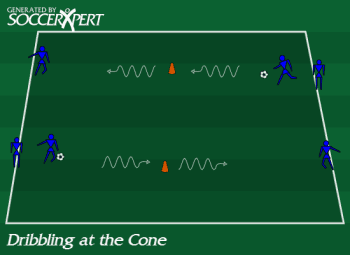
- 1
Organize the players
Make groups of three, one grid each — two players on one side with the ball, one across from them, the 9-inch cone in the middle.
“Threes! Two of you here with the ball, one across the way — that cone in the middle is your defender.”
- 2
Show the jobs
Walk one trip — dribble at the cone under total control, change the ball's direction as you make your move around it, then push the speed to finish at the far side and lay the ball off to the waiting player, who runs the same fake coming back.
“Dribble right at it, make your move, and go — then pass it off. Your teammate does it coming back.”
- 3
Play
Keep the trips rolling and hold the standard — a controlled approach to the cone, a real change of direction, the move sold like the cone might buy it, and a burst of speed after.
“Sell it! Make that cone believe you — then burst!”
Look for The change of direction — the ball actually moving onto a new line at the cone, not just a body wiggle over it.
- 4
Switch and repeat
Play continues until you call a new feint, then everyone runs that one — the scissors, the swerve, or a hard step with a dropped shoulder and a change of direction.
“New move! This one's the scissors — sell it big.”
If every move looks like the same wiggle, stop the line and ask — what would make a real defender lean the wrong way? Let a player answer out loud, then attack the cone again.
Go deeper · 3 notes
Why it works
With no opponent, all the attention goes to the move itself — approach under control, sell the fake, change the ball's direction, burst away — the exact edge a dribbler needs on the day the cone becomes a defender.
What they learn
Dribbling without opposition — total control on the approach, a convincing fake, a clean change of direction at the cone, and a burst of speed past it.
What's next
Dribbling to Beat a Defender — the same move and burst, now against a live defender on the middle line.
Where does this come from?
SoccerXpert — their published drill library.
A published drill library. Useful and widely used, but not a governing body — so it fills gaps rather than leading.