Angle of Support
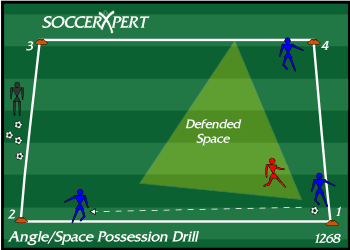
Three players, four corners, one ball — pass to a neighbor, and the free player sprints to fill the open corner next to the ball.
Support is a position before it is a pass — keeping both corners beside the ball covered teaches players to see the next spot and move before the ball does.
Starting at Core — your team is set to mixed.
15 min tonight · Groups of 3
- Ages 5–14
- Groups of 3
- 15 min as the drill is written
- 4 cones, 1 ball per group
Grab Four cones and a ball per group.
Build Build a 10-by-10-yard square. One square per group of three.
Place Each player stands near a different corner — one corner stays empty. Ball starts with one player.
- 1
Organize the players
Groups of three, one square each. Stand each group at three different corners of their square with one ball.
“Three corners covered, one empty. Ball starts in a covered corner.”
- 2
Show the jobs
Walk the one rule — never leave an empty corner next to the ball. The pass goes to a neighboring corner, so the player left behind sprints to fill the open corner beside the new ball carrier.
“One rule — the player with the ball always has both neighbors. Pass, and somebody moves.”
- 3
Play
Keep it flowing — there is no defender, so the drill is the thinking. Watch that players anticipate the ball's next move instead of reacting to it.
“Think ahead — know your next corner before the pass leaves!”
Look for The early mover — a player heading for the open corner while the pass is still traveling.
- 4
Switch and repeat
When the pattern is smooth, tighten it — two touches, then one. Then step in yourself as a passive defender to make the angles real.
“Two touches now! And beat me to the angle — I'm coming in.”
If they stand still after a pass, freeze it and ask which corner has to be filled right now — let a player say it, then play on.
Go deeper · 3 notes
Why it works
Stripping out the defender leaves only the thinking — every pass creates a new empty corner, and the player who anticipates it is learning to support in undefended space, the exact habit keep-away demands once pressure is real.
What they learn
Angle of support, spacing, and moving to the next supporting position before the ball arrives.
What's next
5v2 Angle of Support — the same angles, now with two live defenders hunting.
Where does this come from?
SoccerXpert — their published drill library.
A published drill library. Useful and widely used, but not a governing body — so it fills gaps rather than leading.