Down and Back Dribbling Game
Two groups dribble across the grid and back through each other's traffic — the first player back each run earns a point, and first to five takes the set.
Dribbling in high-traffic, high-pressure situations while staying in control is the skill — and every part of the foot gets a say.
Starting at Core — your team is set to mixed.
10 min tonight · Two groups, one ball each
- Ages 4–10
- Two groups, one ball each
- 10 min as the drill is written
- Cones, balls
Grab Cones and a ball for every player.
Build Build a grid about 20 by 20 yards.
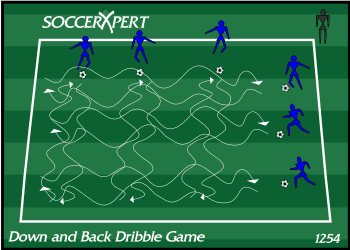
Place Line the two groups up outside the grid facing inward, on two sides that touch — half the team on one side, the other half on the side next to them.
- 1
Organize the players
Split the team into two groups, every player with a ball, and line them up outside the grid facing inward on two adjacent sides.
“Two teams, two sides — you're neighbors, not opposites. Ball at your feet, toes on your line.”
- 2
Show the jobs
Walk the run — on your command, everyone dribbles to the other side of the grid and back to their starting position, down and back. The two groups cross through the middle. The first player back in each group gets a point, and the first player to 5 wins that set.
“Down and back, quick as you can — first one home in your group scores.”
- 3
Play
Run the races and play 3 to 4 sets. Keep heads up for awareness and to avoid collisions, and the ball at a close, safe distance — too far out front and it most often hits another player or gets lost.
“Heads up in the middle! Keep it close — a big touch gets swallowed in there.”
Look for The close touch in traffic — the ball a safe distance from the feet, never so far ahead that it runs into another player.
- 4
Switch and repeat
Between sets, change the run — have players turn or cut when they reach the far side, restrict touches to a certain foot or part of the foot (left foot only, outside of the foot only), or place even groups on all four sides for the same game, making the grid a bit larger there and letting them dribble with speed.
“New set — left foot only! First to five takes it.”
If the middle turns into a pileup, slide two cones out and grow the grid while they run — more room to steer through — then close it back in as control improves.
Go deeper · 2 notes
Why it works
The crossing paths make the traffic — two groups sharing one middle means every run is high-pressure dribbling — and the race keeps the speed honest while control decides who actually gets back first.
What they learn
Dribbling in high-traffic, high-pressure situations while staying in control — heads up to avoid collisions, the ball at a close, safe distance, and control with all parts of the foot.
Where does this come from?
SoccerXpert — their published drill library.
A published drill library. Useful and widely used, but not a governing body — so it fills gaps rather than leading.