2v1 Two-Grid Possession Rondo
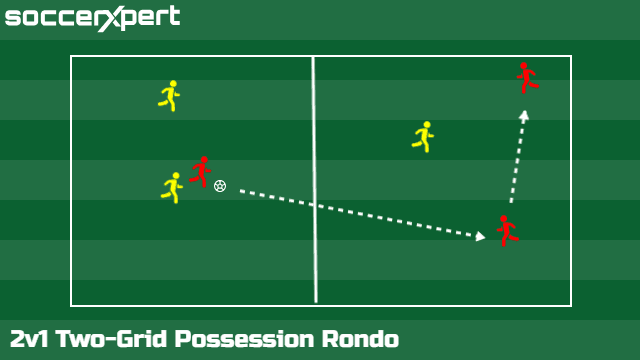
Two attackers work keep-away from a lone defender in a tight grid, with a teammate in the next grid as a quick outlet — string your pass count together to earn the point.
Keeping the ball under pressure and using support — sharp first touches, quick scanning, and constant movement, with an outlet who only gets one or two touches.
Starting at Core — your team is set to mixed.
20 min tonight · Two teams of 3 (2v1 per grid)
- Ages 12+
- Two teams of 3 (2v1 per grid)
- 20 min as the drill is written
- Cones, pinnies, balls
Grab Cones, pinnies for the two teams, one ball to start play, and spares for resets.
Build Build a grid 8 yards wide by 12 yards long and divide it in half — two connected 8-by-6 grids, with cones marking the outer lines and the dividing line.
Place Two attackers from one team and one defender from the other in each grid, with the ball starting with the two attackers in one grid.
- 1
Organize the players
Split six players into two teams of three. In each grid, place two attackers from one team and one defender from the other, and pick the pass count that earns a point.
“Two of you keep it in here — your third is next door. That's your outlet; use them.”
- 2
Show the jobs
Walk the links — the two attackers combine with quick passes and movement to keep the ball from the defender; they can play their teammate in the adjacent grid to escape pressure, but that player must return it in one or two touches, right away; and if the defender wins it, they play it straight into their own attacker waiting in the next grid to keep their team involved.
“Under pressure? Play it next door — but outlet, you get two touches, tops. Defenders — win it and feed your own team.”
- 3
Play
Run the count — the set number of consecutive passes earns the point, and play flows back and forth between the grids. Coach constant movement, with the free attacker always adjusting to open a passing angle; no standing on the dividing line — the player next door stays ready, not parked; the link player playing fast before the defender recovers and closes the gap; a scan over the shoulder before the ball arrives; back-foot or half-turned receiving so the next pass is already open; and loud, early calls for the ball.
“Move — give her an angle! Check your shoulder — know your next pass before it comes!”
Look for The scan — a look over the shoulder before the ball arrives, so the next pass is already decided.
- 4
Switch and repeat
Reset with a new ball and rotate defenders after each point or on a set time, such as 90 seconds. For later rounds, add a second ball to force faster decisions and communication, limit the attackers to two touches, let the defender follow into the adjacent grid on a turnover for a fluid 2v2, shrink the grid, or raise the pass count needed to score.
“Point! New ball, new defender in. This round they can chase you across the line — 2v2!”
If the pairs can't hold the ball in that tight space, widen the grid while they play, then bring it back in as the passes start to come.
Go deeper · 2 notes
Why it works
A 2v1 in a tight grid is a real test of quick touches and quick thinking, and an outlet limited to one or two touches forces sharp first touches, fast scanning, and constant movement to support the ball — while the defender's link to their own teammates keeps every player involved on each turnover.
What they learn
Tight combination play under pressure — support angles, back-foot receiving, one-and-two-touch speed, scanning before the ball arrives, communication, and staying composed under pressure.
Where does this come from?
SoccerXpert — their published drill library.
A published drill library. Useful and widely used, but not a governing body — so it fills gaps rather than leading.