4-Grid Rondo: 2v1 Plus Neutral Overload
Four small grids each run 2v1 keep-away while two floating neutrals read both their grids and step in wherever help is needed — and a defender who wins it counters on a small goal.
It builds tight possession and the scanning habit at once — the neutrals must read two games and decide, on their own, which team needs help right now.
Starting at Core — your team is set to mixed.
20 min tonight · 14 players — 8 attackers, 4 defenders, 2 neutrals
- Ages 12+
- 14 players — 8 attackers, 4 defenders, 2 neutrals
- 20 min as the drill is written
- Cones, pinnies, balls, Pugg goals
Grab Cones, pinnies in three colors — attackers, defenders, neutrals — balls, and four small goals, with cones or flags to mark them if needed.
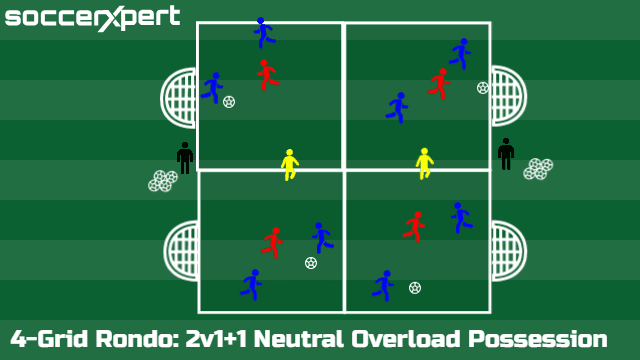
Build Mark a 25-by-25 square and divide it into four equal grids of roughly 12-by-12, with a small goal on the outside edge of each quadrant, facing in.
Place A 2v1 in each grid — two attackers against one defender — and the two neutrals standing on the shared boundary lines between grid pairs, each able to step into either neighbor.
- 1
Organize the players
Split 14 players into four attacking pairs, four defenders — one per grid — and two neutrals standing on the shared lines between adjacent grids, each group in its own pinny color.
“Pairs, you keep it. One hunter per grid. Neutrals — you belong to two grids at once; go where you're needed.”
- 2
Show the jobs
Walk the flow — each pair keeps possession from the lone defender, moving the ball quickly to find open lanes; the neutral constantly scans both neighboring grids and steps into whichever needs an extra body, making that grid a 3v1 — one grid at a time, switching sides as soon as the other needs support more; and a defender who wins the ball immediately attacks the small goal on their own quadrant.
“Eight passes in a row is a point. Hunters — win it and score on your goal, that's two. Neutrals — keep your head moving.”
- 3
Play
Run the score — eight consecutive passes earns the attacking side a point, a defender goal earns two, and every score or ball out restarts with the attackers. Watch that the neutrals are really scanning both grids rather than parking in one; push one- or two-touch play once they're comfortable; look for attackers spreading to the corners of their grid instead of bunching; coach receiving on the back foot so the first touch goes straight to the neutral or an open teammate; and remind defenders to press lanes and angles, not just chase the ball.
“Corners — stretch that grid! Back foot — take it facing your help!”
Look for Neutrals scanning both their grids and moving on their own read — not parked in one game.
- 4
Switch and repeat
Keep the running score for the full period. For later rounds, add a second neutral per grid pairing for a bigger overload with younger or newer players, shrink the grids for advanced groups, add a two-touch limit once the pattern is down, or let a neutral score by dribbling into an open outside goal.
“New rule — neutrals can score too! Dribble into an open goal and steal a point.”
If the pairs can never string passes together, add a second neutral to each grid pairing — a bigger overload until the ball moves, then take it back out.
Go deeper · 2 notes
Why it works
Tight 2v1 possession makes the ball move fast and support matter, but the real teaching point sits with the neutrals — reading two games at once and deciding alone which needs help is a decision players make every match — and the instant counter to a small goal trains transition the moment possession changes, with the point system making every pass and turnover worth fighting for.
What they learn
Tight possession and support in a 2v1, the scanning habit, back-foot receiving, instant transition on the turnover, and defenders pressing lanes and angles rather than chasing the ball.
Where does this come from?
SoccerXpert — their published drill library.
A published drill library. Useful and widely used, but not a governing body — so it fills gaps rather than leading.