4v2 Double Grid Dribble to Penetrate
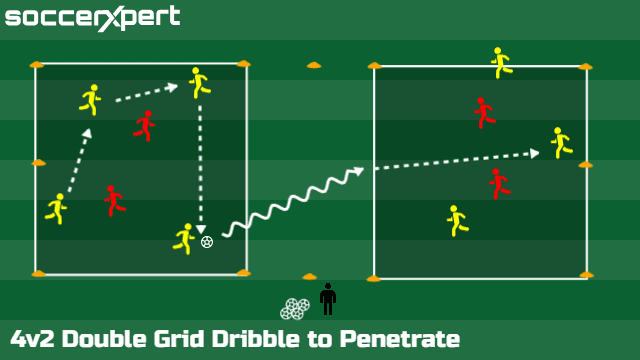
Four attackers hold a 4v2 in one grid until a gap opens — then one drives the ball across open space into the second grid, where teammates are waiting to keep it alive.
Most young players learn to keep the ball; fewer learn when to carry it into space on purpose — this builds the courage to dribble forward and the vision to combine once you get there.
Starting at Core — your team is set to mixed.
25 min tonight · 7 attackers vs 4 defenders (4v2 per grid)
- Ages 12+
- 7 attackers vs 4 defenders (4v2 per grid)
- 25 min as the drill is written
- Cones, pinnies, balls
Grab Cones, yellow pinnies for the seven attackers, red for the four defenders, and several balls for quick restarts.
Build Build two 12-by-12 grids spaced 10 to 12 yards apart, with open space between them.
Place Four attackers and two defenders in the first grid, three attackers and two defenders in the second — the ball starts in the first grid.
- 1
Organize the players
Set out 11 players — 7 attackers in yellow, 4 defenders in red. Put 4 attackers and 2 defenders in the first grid, 3 attackers and 2 defenders in the second, and start the ball with the first grid.
“Yellows keep it, reds hunt — but reds, your grid is your cage. You never chase into the middle.”
- 2
Show the jobs
Walk one crossing — the four keep possession with short passes and movement, working the extra man; defenders defend only inside their own grid and never chase into the space between; when an attacker sees an opening, they dribble out, across, and into the second grid, where the three attackers open passing lanes and offer an easy pass in. Once the ball arrives, that grid plays 4v2 and the grid left behind plays on with three.
“Work the extra man until the door opens — then drive through it. Far grid, be ready to hand them an easy pass.”
- 3
Play
Keep a running tally of defender wins across both grids — an interception, a tackle, or a ball out of bounds all count. Coach the carry — head up before crossing so the dribbler arrives already knowing where the pass goes; the 4v2 advantage used to draw defenders before anyone goes; the waiting attackers always moving, never standing targets; a simple call like here or gap so the dribbler commits with confidence; and defenders staying disciplined in their own grid.
“Head up before you go — know your pass before you get there! Call it for them — gap!”
Look for Dribbles that leave on time — after the extra man has drawn defenders and real space opens, not before.
- 4
Switch and repeat
When the defenders combine for 10 wins, rotate a fresh pair of defenders into each grid and reset the tally. For later rounds, add a third defender to one grid who may track the attacker across for a 4v3, cap possession at 3 passes before someone must dribble across, go two-touch or one-touch inside the grids, require a specific finish like a firm ground pass or a first-time lay-off, or move the grids closer together or farther apart.
“That's ten wins — fresh reds in! New round: three passes max, then somebody drives.”
If dribblers keep getting caught in the open space, the grids may be too far apart — move them closer — or the players aren't scanning before they go.
Go deeper · 2 notes
Why it works
Holding a numbers-up 4v2 gives attackers a safe platform, but the real read is the exit — a bold decision to drive the ball across open space and keep the play alive on the other side — so players learn to dribble with a purpose, not just to beat a defender for the sake of it, while practicing supporting angles, scanning, and patient numbers-up possession along the way.
What they learn
Dribbling to penetrate — reading when real space opens, scanning before the carry, supporting angles on arrival, patient numbers-up possession, communication, and speed of play once restrictions arrive.
Where does this come from?
SoccerXpert — their published drill library.
A published drill library. Useful and widely used, but not a governing body — so it fills gaps rather than leading.