3-Second Transition Game
A 4v4 possession game where winning the ball starts a 3-second clock — three quick passes or a dribble through a gate before it runs out earns the point.
The first three seconds after a turnover are the most important moments in any game — this drops players into that chaos and builds the habits to handle it.
Starting at Core — your team is set to mixed.
20 min tonight · Two teams of 4 (4v4)
- Ages 12+
- Two teams of 4 (4v4)
- 20 min as the drill is written
- Cones, pinnies, balls
Grab Cones for the grid and gates, pinnies in two colors, and 6 to 8 extra balls.
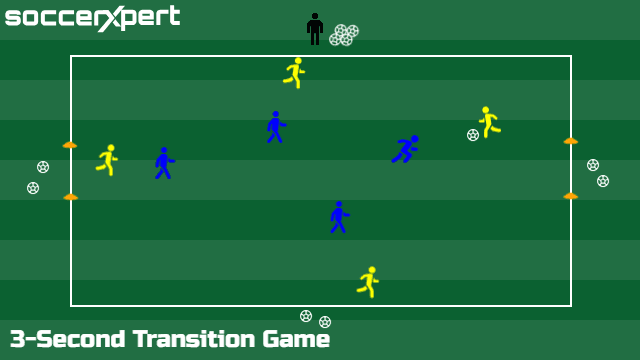
Build Build a 20-by-25-yard grid with a target gate about 2 yards wide of cones on each end.
Place Both teams of four inside the grid — no goalkeepers needed — with the extra balls scattered around the outside so play restarts quickly.
- 1
Organize the players
Split into two teams of four in different colored pinnies, both inside the grid, and assign one team to start with possession.
“Four v four — colors on. Reds start with the ball, but the real game starts when somebody wins it.”
- 2
Show the jobs
Walk the trigger — the teams play live 4v4 possession, and the moment a team wins the ball, you or a player calls "Go!" to start the 3-second count. Three consecutive passes or a dribble through either gate before it runs out earns a point and play continues; fail, and possession resets to the other team while you roll in a new ball to keep the tempo high. The team that just lost it must sprint — press the ball and get compact behind it immediately.
“Win it and you'll hear GO — three passes or a gate in three seconds. Lose it? You're sprinting, not watching.”
- 3
Play
Run rounds of 4 to 5 minutes with a short rest between — first team to 10 points wins the round. Watch the first reaction after a turnover — first steps toward the ball or toward cover within one second, the player nearest the ball pressing immediately instead of watching from a distance, support angles showing fast so the ball carrier has an easy pass, a compact shape with no big gaps between defenders, and voices calling for the ball or calling out the press.
“React! First step NOW — nearest player presses, everybody else get tight and connected!”
Look for The first second after a turnover — first steps toward the ball or toward cover immediately, not three seconds later.
- 4
Switch and repeat
Rest, reset, and race to 10 again. For later rounds, add a neutral floater who always plays with the possession team, shrink the grid to 15-by-20, award a bonus point for a gate within 3 seconds of winning the ball, make all three passes one-touch only — or, for advanced groups, drop the 3-second clock and coach purely the quality of decisions and movement after turnovers.
“New round — the floater's in, and they always play with the ball. First to ten!”
If players lose the ball and just stand there, freeze the game and walk through the correct response together — then play on.
Go deeper · 2 notes
Why it works
The 3-second clock puts real pressure on the exact moment that decides games — it forces fast thinking, quick movement, and clear communication from the team that won the ball, while the team that lost it learns there is no standing still, only pressing, closing space, and getting compact. Run it often and the sharp, confident decisions show up on game day.
What they learn
Reacting inside the first seconds of a turnover — immediate pressing by the nearest player, closing space, compact shape with no gaps, fast support angles for the ball carrier, quick passing decisions, and constant communication.
Where does this come from?
SoccerXpert — their published drill library.
A published drill library. Useful and widely used, but not a governing body — so it fills gaps rather than leading.