Free Dribble
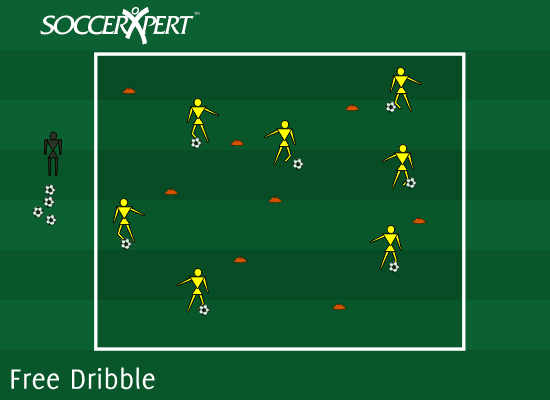
Every player dribbles freely around a coned grid — all surfaces of both feet, changes of speed and direction, and cones standing in as imaginary defenders.
Unlimited touches and free experimentation build a natural feel for the ball — and the confined space quietly demands the close control that shows up in tight game moments.
Starting at Core — your team is set to mixed.
10 min tonight · Whole team, one ball each
- Ages 4–14
- Whole team, one ball each
- 10 min as the drill is written
- Cones, balls
Grab Cones and a ball for every player.
Build Mark an area sized for your group — about 20-by-20 for 12 to 16 players, smaller for advanced players, larger for beginners — and scatter cones randomly inside as obstacles.
Place Every player starts anywhere in the grid with a ball at their feet.
- 1
Organize the players
Bring everyone inside the grid with a ball at their feet.
“Grab a ball and find a spot inside the cones — the whole grid is yours.”
- 2
Show the jobs
Walk the menu — dribble continuously with the ball close and under control; touches with the inside, the outside, the sole, and the laces; frequent direction changes using different turns; speed that varies from slow to fast bursts; cones treated as imaginary defenders to beat or avoid; heads up as much as possible to see the space and other players; both feet equally; and moves, feints, and tricks with no fear of mistakes.
“Every part of your foot gets a turn. The cones are defenders — beat them! Try the move you've never tried — mistakes are free today.”
- 3
Play
Keep them moving for 5 to 10 minutes and coach the habits — maximize touches with the ball close and moving constantly, all surfaces rather than just the comfortable ones, head up between touches, sudden bursts like beating a defender, both feet even when the weak one feels awkward, light feet and bent knees for balance, body feints and shoulder drops, and using the whole space instead of circling one spot. The goal is lots of touches and creativity, not perfection on every move.
“Heads up! Burst — like you just beat somebody! Now the other foot!”
Look for Heads coming up between touches — players seeing the space and each other, not just the ball.
- 4
Switch and repeat
Cycle in fresh challenges — call a specific move or touch for 30 seconds, run follow-the-leader, require a skill at every cone, play knock-out where players protect their ball while tapping others' out, shrink the grid to create traffic, change styles to the tempo of music, run weak-foot-only periods, call a body part to the ground while they keep control, mirror in pairs, set a 10-move challenge, or send walking defenders drifting through the space.
“Thirty seconds — sole rolls only! Now find a partner and copy everything they do.”
If the grid turns into bumper cars, slide the cones out a few steps while they dribble — beginners get a bigger area — then bring it back in as control improves.
Go deeper · 2 notes
Why it works
Unlimited touches with no structured patterns and no defenders build a natural feel for the ball, the confined space demands close control and quick adjustments, and removing the fear of mistakes lets players push their limits — which is where real skill development happens. That freedom is also what makes it a perfect warmup: plenty of touches, self-expression, and fun.
What they learn
Ball mastery and comfort on the ball — all surfaces of both feet, close control, changes of speed and direction, turns, feints, and heads-up awareness of the space.
Where does this come from?
SoccerXpert — their published drill library.
A published drill library. Useful and widely used, but not a governing body — so it fills gaps rather than leading.