The Passing Pyramid
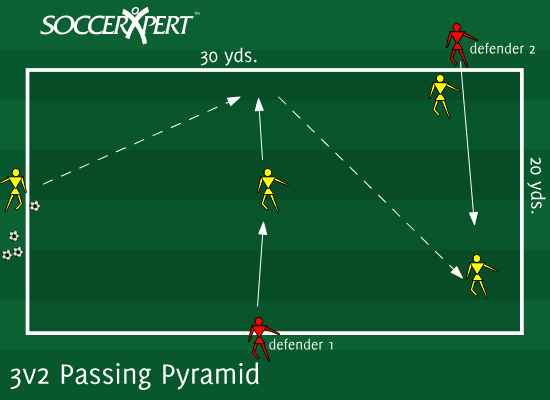
Four players build the ball from the back through a pyramid — defender to midfielder to forwards — while two opponents come in to break it up.
Building out of the back — the pattern every goal kick starts — takes connected lines, patience, and proper spacing, and this is where that foundation gets built.
Starting at Core — your team is set to mixed.
20 min tonight · Groups of 6 (a pyramid of 4, plus 2 opponents)
- Ages 9+
- Groups of 6 (a pyramid of 4, plus 2 opponents)
- 20 min as the drill is written
- Cones, pinnies, balls
Grab Cones, pinnies, and extra balls — keep the spares by the defender's spot to restart play quickly.
Build Mark a rectangle about 20 by 30 meters — sized up or down to fit your players' age and skill.
Place Set the pyramid — one defender at the base with the ball, one midfielder in the middle, two forwards at the top — and stand the two opponents just outside the area, ready to enter.
- 1
Organize the players
Make groups of six — a defender, a midfielder, and two forwards in the pyramid, two opponents waiting outside the area. Ball starts at the defender's feet.
“Defender at the bottom, midfielder in the middle, forwards up top. You two — outside for now.”
- 2
Show the jobs
Walk the pattern — defender plays a short pass to the midfielder, the midfielder finds a forward, and the forward goes wide or switches to the other forward. Show the forwards checking away, then coming back to lose their marker.
“Short passes, to feet — build it one line at a time, no skipping ahead with a long ball.”
- 3
Play
Start the build. After the first pass or two, send the opponents in to press — the pyramid keeps the ball with combinations, movement, and the full width of the area. If it's lost, reset at the defender.
“Pressure's coming — stay calm, use all the width!”
Look for Scanning before the ball arrives — a player who has already looked knows the next pass before the pressure lands.
- 4
Switch and repeat
Rotate positions every few minutes so everyone plays defender, midfielder, and forward.
“Rotate! New spot in the pyramid — new job.”
If the build keeps dying, hold the opponents out — run the pattern unopposed until it flows, then send them back in.
Go deeper · 3 notes
Why it works
The pyramid is your team's real shape in miniature — defenders deep, midfielders between, forwards high — so connecting its lines here is rehearsing how the team plays out from the back in actual games. It builds the habit a goal kick starts, without needing the restart itself.
What they learn
Building from the back — short passes through the lines, showing for the ball at clear angles, spacing across the full width, and calm decisions under pressure.
What's next
Playing Wide Out of the Back — the same build-out habit, now inside a live 4v4 game.
Where does this come from?
SoccerXpert — their published drill library.
A published drill library. Useful and widely used, but not a governing body — so it fills gaps rather than leading.