Breaking Ball Combination Drill
A quick 1-2 at the center stick, then the runner spins around it and the breaking ball arrives in stride — a pass and a run learning to agree, over and over.
The breaking ball and the run have to arrive together — this builds the connection between passer and runner that breaks down defenses in games.
Starting at Core — your team is set to mixed.
20 min tonight · Two lines plus 2 combination players
- Ages 9+
- Two lines plus 2 combination players
- 20 min as the drill is written
- Cones, balls, practice sticks
Grab Three practice sticks — or mannequins — two cones, and a ball for every player in the lines.
Build Stand the three sticks in a straight line, 4 to 5 yards apart, and place a cone 7 to 10 yards from the center stick on each side.
Place A combination player on each side of the center stick, everyone else split evenly between the two cones with a ball each — twelve or more players, build a second identical setup to maximize touches.
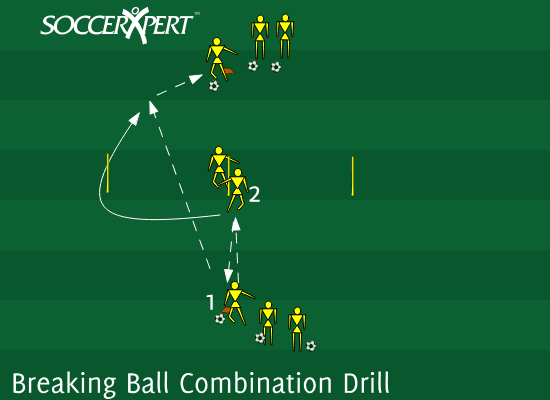
- 1
Organize the players
Put a combination player on each side of the center stick and split the rest evenly between the two cones, every player there with a ball.
“Two lines at the cones, ball each. You two — you live at the middle stick for now.”
- 2
Show the jobs
Walk one repetition — Player 1 at the cone passes to Player 2 near the center stick, firm and to feet; Player 2 plays a one-touch return, and the moment it's away they sprint around the outside of the left stick; Player 1 plays the breaking ball between the left and center sticks into the space, and Player 2 receives it on the run and passes across to the player at the opposite cone. Then rotate — Player 1 moves to the center, Player 2 to the back of the opposite line.
“Give-and-go — the second you lay it off, you're running. And the pass goes into the space, not at your feet.”
- 3
Play
Run both sides at the same time, with every run going left to start. Watch the timing — the run starts the moment the return pass is played, never before; the breaking ball weighted so it's collected in stride, aimed into the space between the sticks rather than at the runner; runs accelerating at game speed; bodies open to receive on the correct foot for the direction; and a simple call for the ball to help the timing.
“Game-speed runs — accelerate! Passers, into the space — let the run meet the ball!”
Look for The timing of the run — moving the moment the return pass is struck, not before it.
- 4
Switch and repeat
After several repetitions, switch the pattern so the runs go around the right stick instead. For later rounds, add a passive defender between the sticks so the passer must disguise the ball, have the runner finish on a small goal, name the final pass — driven, chipped, or outside of the foot — add a fake run before the cut, spread the sticks for longer breaking balls, count combinations in 60 seconds, or cap the runner at two touches.
“Switch it — runs go right now! Same timing, new side.”
If both sides going at once falls apart, run one side at a time until they understand the pattern — then turn the second side back on.
Go deeper · 2 notes
Why it works
The 1-2 sets the tempo and then asks for the real thing — a well-timed run and a breaking ball weighted into space — so the passer learns the weight and the runner learns the moment, and that passer-runner connection is exactly what breaks down defenses during games.
What they learn
Playing accurate breaking balls into space with the right weight, timing runs off a quick 1-2, accelerating at game speed, opening the body to receive on the correct foot, and calling for the ball.
Where does this come from?
SoccerXpert — their published drill library.
A published drill library. Useful and widely used, but not a governing body — so it fills gaps rather than leading.