2v1 with Keepers
Two attackers take on one defender to a small goal with keepers behind — score, or put the ball out of play three times, and new players rotate in.
A 2v1 teaches attackers to exploit a numerical advantage while the defender learns to delay and disrupt — and behind them, the keepers work on distribution and decision-making.
Starting at Core — your team is set to mixed.
20 min tonight · Two teams, plus 2 keepers (2v1)
- Ages 9–14
- Two teams, plus 2 keepers (2v1)
- 20 min as the drill is written
- Cones, pinnies, balls, BowNet goal
Grab Cones, pinnies in two colors, balls, and your goals — practice sticks, cones, or markers set the goal width if you're short.
Build Build a 30-by-15 field with a 4-by-6-yard goal on each end line.
Place Each team defends one goal and attacks the other, with a keeper starting in each goal.
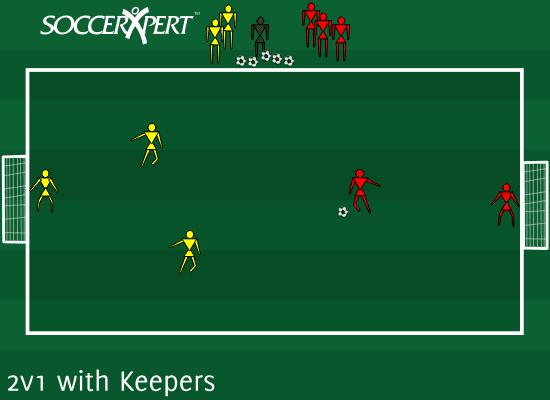
- 1
Organize the players
Divide the group into two teams in alternate colors, assign each a goal to defend, and start a keeper in each goal.
“Two teams, two goals. Keepers in — everybody else rotates through.”
- 2
Show the jobs
Walk the restarts — play begins as a 2v1 attack in the attacking team's favor; a ball out of bounds belongs to the first player to reach it, restarted with a kick-in or dribble-in from the sideline; anything over the end line, the keeper restarts.
“Dead ball? First one there wins it — kick it in or dribble it in. Over the end line, your keeper starts us again.”
- 3
Play
Run the 2v1 and watch both jobs — attackers using quick combination play, creating space, and exploiting the defender's positioning; the defender delaying the attack, forcing the attackers wide, and anticipating passes; keepers talking to their defender and distributing well. Push fast decisions, well-timed passes, and body positioning that shields the ball.
“Quick decisions! See what the defender gives you — and shield that ball!”
Look for Timing — combinations played quickly and the pass released at the right moment, not after the chance dies.
- 4
Switch and repeat
After a goal, or after the ball goes out of play three times, rotate new players in — and alternate who attacks and who defends so everyone gets both jobs in the 2v1. For later rounds, add a time limit per attack, limit the attackers' touches, or play 3v2 or 3v1.
“That's three dead balls — new group in! Attackers, you're defending next turn.”
If the attackers keep dithering until the chance dies, freeze it and ask — what is the defender giving you? Let them answer, then play on.
Go deeper · 2 notes
Why it works
The continuous 2v1 puts every job in one game — attackers exploiting a numerical advantage, a defender delaying and disrupting, keepers whose distribution and decisions restart everything — with quick transitions between roles built into the rotation itself.
What they learn
Exploiting a 2v1 — quick combination play, creating space, and reading the defender's positioning — plus delaying and forcing play wide on defense, shielding the ball, and goalkeeper communication and distribution.
Where does this come from?
SoccerXpert — their published drill library.
A published drill library. Useful and widely used, but not a governing body — so it fills gaps rather than leading.