Variable Distance Passing Game
Pairs pass through a small gate from 5 yards, then 10, then 15 — three good passes moves you back a marker, two misses in a row moves you up one.
Every distance asks for a different pass — players learn to adjust power and precision as the range grows, and to keep it consistent under pressure.
Starting at Core — your team is set to mixed.
15 min tonight · Pairs, one ball per pair
- Ages 4–10
- Pairs, one ball per pair
- 15 min as the drill is written
- Cones, balls, practice sticks
Grab Cones, practice sticks for the gates, and a ball for every pair.
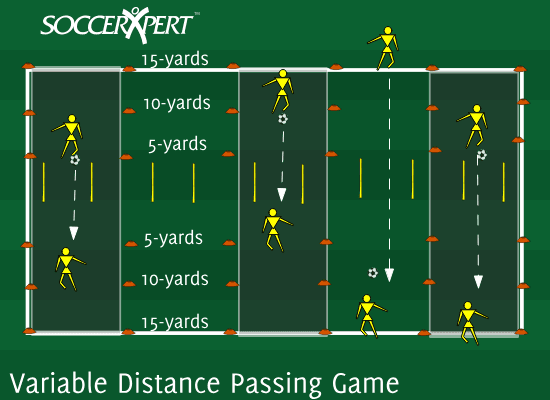
Build Mark a 20-by-30-yard field into lanes, set a small gate — its width is adjustable — in the middle of each lane, and mark distances at 5, 10, and 15 yards from the gate with cones.
Place Each pair takes a lane with its ball and begins at the 5-yard marker, the gate between them as the diagram shows.
- 1
Organize the players
Pair everyone up, give each pair a ball and a lane, and start them at the 5-yard markers.
“Find a partner, find a lane — you're both starting at the closest marker.”
- 2
Show the jobs
Walk the ladder — pass through the gate to your teammate, who passes it back through. Three successful passes moves the pair back to the 10-yard marker, three more sends them to 15 for the final challenge — and a player who misses two in a row moves forward one marker and must complete three there before advancing again.
“Three good ones through the gate and you back up. Miss two in a row and you move in — earn your way back out.”
- 3
Play
Run the round. Watch for the inside of the foot for accuracy, power adjusted to the distance, bodies facing the target with a follow-through, a controlled first touch that sets up the next pass, and partners calling for the ball and timing their passes.
“Inside of the foot! The farther back you go, the more you give it!”
Look for Weight of pass — power adjusted to the distance instead of one speed for every range.
- 4
Switch and repeat
First pair to complete all three distances wins the round — reset and play again. For later rounds, narrow the gates, require the weaker foot, race a set time, have players move laterally after each pass, or ask advanced pairs for one-touch passing once they clear 5 yards.
“New round — weaker foot only. Same ladder!”
If nobody can buy a pass at the first marker, widen the gates — they're built to adjust — then narrow them back as the passes start flying through.
Go deeper · 2 notes
Why it works
The ladder only moves when the passes earn it — three successes to back up, two misses to move in — so every pair works at the distance that stretches them, adjusting power and precision as the range changes and holding it consistent under pressure.
What they learn
Passing accuracy at varying distances — inside-of-the-foot technique, weight of pass matched to the range, body position and follow-through, a controlled first touch, and calling for the ball with good timing.
Where does this come from?
SoccerXpert — their published drill library.
A published drill library. Useful and widely used, but not a governing body — so it fills gaps rather than leading.