Dribbling with Pressure on the Back
The ball shoots through your legs from behind — find it fast and dribble it to the far side of the grid while your partner chases and tries to take it.
Protecting the ball with a defender on your back is its own skill — this builds the awareness, quick reactions, and body positioning that keep possession under pressure.
Starting at Core — your team is set to mixed.
15 min tonight · Pairs (1v1)
- Ages 4–12
- Pairs (1v1)
- 15 min as the drill is written
- Cones, balls
Grab Cones and a ball for every pair.
Build Build a grid 20 by 15 yards.
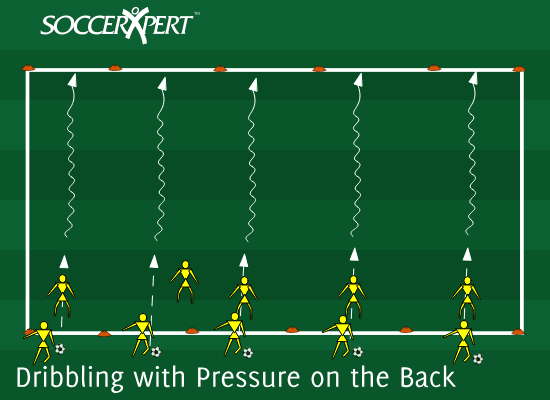
Place Pairs spread out — each dribbler in front with legs spread wide, each defender directly behind holding the ball.
- 1
Organize the players
Split into pairs with one ball each, spread out in the grid. Front player is the dribbler — legs spread wide, eyes forward. Partner stands directly behind with the ball.
“Partners! One in front, legs wide, no peeking. One behind with the ball — wait for me.”
- 2
Show the jobs
Walk it — on your command, the defender passes the ball through the dribbler's legs. Without looking back first, the dribbler must locate the ball quickly and dribble for the opposite side of the grid while the defender applies pressure and tries to win it — shielding and protecting the whole way.
“When I shout, it comes through your legs. Find it, shield it, get it across — your partner is coming for it.”
- 3
Play
Run the crossings. Watch for the dribbler's body kept between ball and defender, the ball kept close, an instant reaction the moment they see the ball, defenders pressuring realistically without fouling, and the right choice between turning, shielding, and accelerating into space.
“React — go find it! Body between, keep it close!”
Look for The shield on the move — body kept between ball and defender the whole way across, not just a footrace.
- 4
Switch and repeat
Reaching the far side flips the roles, and play runs back the other way. Keep it going for your set time or number of rounds so everyone gets equal turns. For later rounds — the pass can go slightly left or right instead of through the middle, or a dribbler who loses possession becomes the defender in the next round automatically.
“Made it? Trade jobs — back the other way. This time the pass might not come straight!”
If the defender wins it every single time, freeze it and ask the dribbler — where was your body? Let them say it — between the ball and the pressure — then run it again.
Go deeper · 2 notes
Why it works
It enhances ball control, shielding, and reaction time by simulating real-game pressure from a defender — and because the ball arrives through their legs, the dribbler must find it and react to what they see rather than start in control.
What they learn
Ball protection under pressure — shielding, body positioning, keeping the ball close — plus instant reactions, scanning, and choosing when to turn, shield, or accelerate into space.
Where does this come from?
SoccerXpert — their published drill library.
A published drill library. Useful and widely used, but not a governing body — so it fills gaps rather than leading.