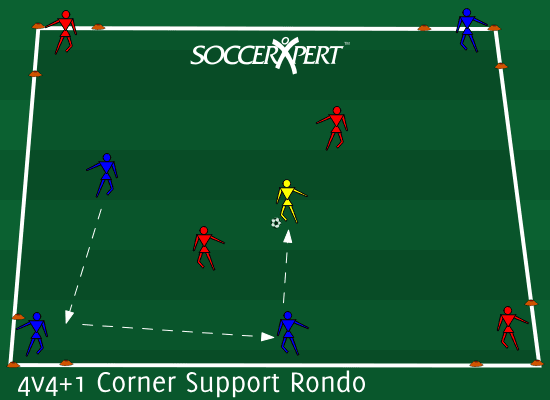
4v4+1 Corner Support Rondo
Two teams battle for the ball in the middle while corner teammates and a neutral player give it a way out — possession is the whole game.
Using every outlet — the corners, the neutral, the open teammate — is what keeps the ball under pressure, and finding them builds composure and transition awareness.
Starting at Core — your team is set to mixed.
20 min tonight · Two teams of 4 plus a neutral (9)
- Ages 9+
- Two teams of 4 plus a neutral (9)
- 20 min as the drill is written
- Cones, pinnies, balls
Grab Cones for the square and its corners, pinnies for the two teams, and a ball.
Build Build a 15-by-15-yard square and mark a small triangle at each corner.
Place Each team puts two players in diagonally opposite corners and two inside the square; the neutral floats inside.
- 1
Organize the players
Two teams of four in pinnies plus one neutral. Each team — two players in diagonally opposite corners, two inside. Neutral starts inside.
“Corners — hold your triangle. Middles — the square is yours. Neutral — you're always with the ball.”
- 2
Show the jobs
Walk one possession — the ball works through the inside pair, out to a corner and quickly back, with the neutral always joining the team that has it. When the defenders win it, the corners and neutral flip their support to the new team.
“Corners — catch it and give it right back. Defenders — win it and it all flips to you.”
- 3
Play
Start it with a pass to one team. Play rounds of three to five minutes, keeping the emphasis on movement, passing, and the moment of transition.
“Sharp passes! Corners are your reset — use them!”
Look for The corner reset — a team under pressure using the stationary teammate to escape and keep possession.
- 4
Switch and repeat
Rotate the corner players each round so everyone gets the inside work.
“New round — corners in, middles out!”
If possession keeps dying inside, add a second floating neutral — one more passing option until it flows.
Go deeper · 2 notes
Why it works
The corners never move and the neutral always helps the ball, so the team in possession always has an outlet if they can see it — finding the reset under pressure is composure, made trainable.
What they learn
Quick passing, movement off the ball, using stationary teammates as a reset, and transition awareness.
Where does this come from?
SoccerXpert — their published drill library.
A published drill library. Useful and widely used, but not a governing body — so it fills gaps rather than leading.