Diagonal 1v1
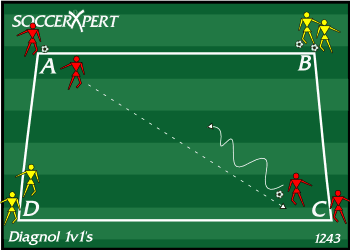
A long diagonal pass across the grid becomes an instant 1v1 — the receiver attacks the corner the pass came from, and the passer defends it.
The same rep works both ends of a 1v1 — the attacker's speed, explosive change of pace, and drive to get behind, and the defender's quick close-down that forces the attack to the side.
15 min tonight · Four groups, one per corner
- Ages 4+
- Four groups, one per corner
- 15 min as the drill is written
- Cones, pinnies, balls
Grab Cones, pinnies, and balls.
Build Set up a 15-by-15-yard grid.
Place One group on each corner — call them A, B, C, and D. The two groups next to each other, A and B, start with the balls.
- 1
Organize the players
Split the team into four groups and send one to each corner of the grid. The two adjacent corners, A and B, start with the balls.
“Four corners, four groups. A and B — the balls start with you.”
- 2
Show the jobs
Walk one rep — the first player in group A plays a ball to the first player in group C, on the diagonal corner. C becomes the attacker and attacks the cone A came from; A becomes the defender and tries to deny C from reaching it. The play is dead when the ball leaves the grid or the defender wins possession. Then B plays to D, and it repeats.
“A — pass it across to C, then go defend your cone. C — that cone is yours to attack. Then B and D do the same.”
- 3
Play
Alternate the reps — A to C, then B to D. Attacking, push the speed, the quick explosion to get away, and getting behind the defender. Defending, close down quickly, force the attacker to the weak side, break it down, and close the attack out.
“Attack that cone with speed! Defender — fast, slow, outside, low!”
Look for The close-down — a defender arriving fast, then slowing and stepping back with the attacker, low, forcing them outside.
- 4
Switch and repeat
Keep the corners feeding — A to C, B to D, next players up each time — so everyone gets turns attacking and defending.
“Next two, be ready — the pass is your signal. Everyone attacks, everyone defends today.”
If the diagonal pass keeps dying before it arrives, walk the corners in while they play — a shorter pass and a quicker duel — then grow the grid back out.
Go deeper · 2 notes
Why it works
The pass is the trigger — the moment it travels, one player becomes the attacker and one the defender, so every rep opens as a live duel with a target both players understand: the corner the pass came from.
What they learn
1v1 attacking — speed at the defender, a quick explosion to get away, getting behind — and 1v1 defending by Fast, Slow, Outside, Low — approach fast, slow and step back as you close, force the attacker outside, keep a low center of gravity.
Where does this come from?
SoccerXpert — their published drill library.
A published drill library. Useful and widely used, but not a governing body — so it fills gaps rather than leading.