Hexagonal Rondo
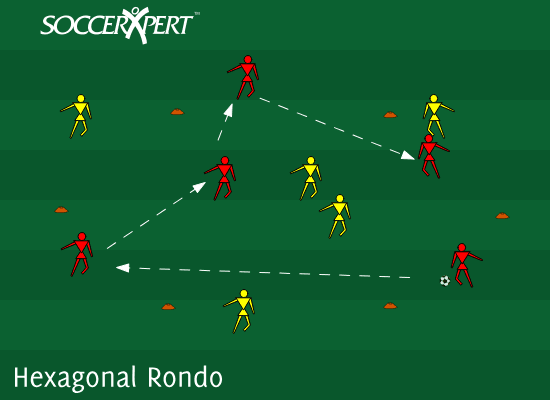
Two teams share a six-sided grid — three per team on the sides, a 2v2 inside — and whoever has the ball keeps it moving through teammates inside and out.
Six sides mean passing angles everywhere — finding them fast builds spatial awareness, quick decisions, and fluid team coordination.
Starting at Core — your team is set to mixed.
15 min tonight · Two teams of 5 (2v2 inside, 3 per team outside)
- Ages 10+
- Two teams of 5 (2v2 inside, 3 per team outside)
- 15 min as the drill is written
- Cones, pinnies, balls
Grab Cones, two colors of pinnies, and a ball.
Build Build a hexagon — six sides, each about 5 to 7 yards, sized to your group.
Place Three players per team spaced around the outside, colors alternating side by side; two players per team inside. Outside players stay on their side.
- 1
Organize the players
Two teams of five in pinnies. Three from each team take a side of the hexagon — alternate the colors around it. Two from each team go inside.
“Outside — you own your side, stay on it. Inside — you four are free.”
- 2
Show the jobs
Walk it — the team with the ball keeps it through their two inside players and their three sides; the other team's inside pair presses to win or intercept, and a steal flips possession immediately.
“Keep it in your colors — use your middles. Steal it, and it's your ball — keep it moving.”
- 3
Play
Start it with a pass to one team and keep it fast — quick turnovers, quick transitions between attack and defense.
“Heads up! Pass and move — slide along your side to help!”
Look for Outside players sliding along their side to open an angle before the ball needs them.
- 4
Switch and repeat
After a minute or two of high-intensity possession, rotate the inside pairs with the outside players.
“Rotate! Middles out, sides in — same jobs, new legs.”
If the ball won't stick with either team, stretch the sides out a step or two while they play — more room calms it down — then bring it back in.
Go deeper · 3 notes
Why it works
Six sides create passing angles a square never offers, and with teammates inside and outside, the team in possession always has a gap to find — the game rewards the player who sees it before the defenders close it.
What they learn
Quick passing, spatial awareness, head-up decisions, and moving into space after the pass.
What's next
4v4+1 Corner Support Rondo — the same inside-outside game, now with corner outlets and a neutral.
Where does this come from?
SoccerXpert — their published drill library.
A published drill library. Useful and widely used, but not a governing body — so it fills gaps rather than leading.