Obstacle Course Dribble
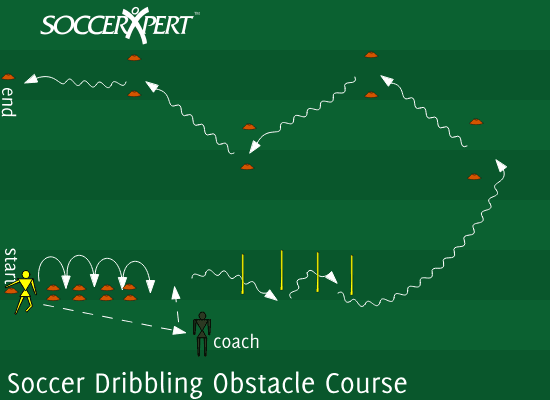
One at a time, players pass to you, bunny-hop the hurdles, take your return pass, slalom the sticks, zigzag the gates, and sprint to the end of the course.
Dribbling around obstacles mimics game situations — navigating opponents and tight spaces — building agility, coordination, and control of the ball under various conditions.
10 min tonight · One line, one ball each
- Ages 8–12
- One line, one ball each
- 10 min as the drill is written
- Cones, balls, practice sticks, small hurdles
Grab Cones, practice sticks, your small hurdles, and a ball for every player.
Build Build the course as the diagram shows — a starting line about 3 yards from the first hurdle, 4 to 6 hurdles or cones a yard apart, then a line of 4 to 6 sticks about 3 yards apart (closer for more skilled dribblers), then 4 to 6 gates 3 yards wide zigzagging 4 yards apart.
Place Every player at the start of the course with a ball — and you where the opening pass can find you.
- 1
Organize the players
Line everyone up at the start of the course, each with a ball — and check that the course is challenging but achievable for their age and skill level.
“One line, right here. Keep your ball with you — it comes to me first.”
- 2
Show the jobs
Walk the trip — on your signal the first player passes to you and bunny-hops over each hurdle; at the end of the hurdles you pass back, and they slalom-dribble through the sticks, dribble the zigzag through each gate, and sprint to the end of the course, then join the back of the line to wait for another turn.
“Pass me the ball and hop the hurdles — I'll give it right back. Sticks, gates, then fly to the finish!”
- 3
Play
Keep the runs coming. Push both feet and different parts of the foot — inside, outside, sole — to maneuver the ball, close control around the cones, heads up as much as possible, and quick, light touches. Let them try different dribbling techniques and speeds.
“Light touches! Eyes up — where's your next gate?”
Look for Quick, light touches that keep the ball in close control around every obstacle.
- 4
Switch and repeat
Keep the line cycling through the course. For later rounds, time each player's run and challenge them to beat their personal best, require the non-dominant foot only, or run a blind dribble — heads up, trying not to look at the ball.
“This one's on the clock — beat your own time! Next round, weak foot only.”
If players keep getting stuck in the sticks, spread them a step or two farther apart while the runs continue — the course should be challenging but achievable.
Go deeper · 2 notes
Why it works
The course mimics game situations — opponents and tight spaces to navigate — so every run builds the ability to control the ball under various conditions, an essential skill for soccer players of all levels.
What they learn
Dribbling around obstacles — agility, coordination, close control with both feet and different parts of the foot, quick light touches, and heads up while maneuvering the ball.
Where does this come from?
SoccerXpert — their published drill library.
A published drill library. Useful and widely used, but not a governing body — so it fills gaps rather than leading.