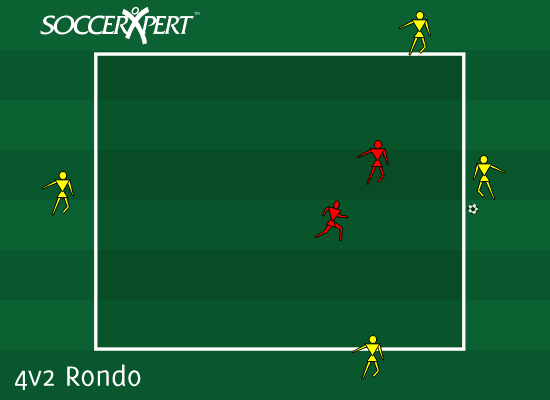
4v2 Rondo
Four players keep the ball away from two defenders in a small square — lose it, and you're in the middle.
Passing angles and moving to support the ball are what keep possession, and a tiny square makes those habits happen at game speed or not at all.
Starting at Core — your team is set to mixed.
10 min tonight · Groups of 6 (4v2)
- Ages 10+
- Groups of 6 (4v2)
- 10 min as the drill is written
- 4 cones, 1 ball per group
Grab Four cones and a ball per group — keep spare balls close for quick restarts.
Build Build a 10-by-10-yard square. One square per group of six.
Place Four passers around the outside of the square, two defenders inside. One passer starts with the ball.
- 1
Organize the players
Split into groups of six — four passers on the sides, two defenders in the middle. Extra players get their own square.
“Four outside, two in the middle. Ball starts outside.”
- 2
Show the jobs
Walk one sequence — pass, then move to a new angle so the ball always has two ways out.
“Passers — keep it moving, and always give the ball two options. Defenders — work together: one presses, one cuts the pass.”
- 3
Play
Two minutes per round. Let the defenders count interceptions and use it as a score.
“Crisp passes, to feet. Move the second you pass!”
Look for Passers moving early — the next angle exists before the ball arrives.
- 4
Switch and repeat
Rotate two new defenders in every round so everyone defends.
“New defenders in! Passers — beat your last count.”
If the passers can't string three together, pull one defender — 4v1 until it flows, then put them back.
Go deeper · 3 notes
Why it works
The square is small on purpose: pressure arrives fast, so support has to arrive faster. A rondo carries its own consequence — lose the ball and you defend — which keeps everyone honest without the coach saying a word.
What they learn
Passing angles, early support, and movement off the ball under real pressure.
What's next
3v1 Transition Rondo — the same habits, now shifting between two squares.
Where does this come from?
SoccerXpert — their published drill library.
A published drill library. Useful and widely used, but not a governing body — so it fills gaps rather than leading.