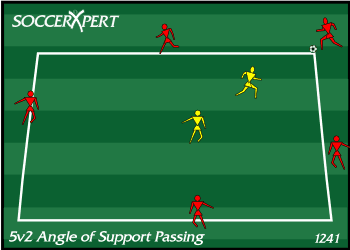
5v2 Angle of Support
Five players around a small square keep the ball away from two defenders inside — ten passes in a row is the win.
Where you stand to receive matters as much as how you pass — support angles, the weight of each pass, and a clean first touch are what keep the ball moving.
Starting at Core — your team is set to mixed.
15 min tonight · Groups of 7 (5v2)
- Ages 9+
- Groups of 7 (5v2)
- 15 min as the drill is written
- Cones, pinnies, plenty of balls
Grab Cones, pinnies for the two defenders, and a good supply of balls to keep it flowing.
Build Build a square about 12-by-12 yards — down to 10-by-10 for a sharper group.
Place Five players spread along the outside of the square, two defenders inside. Ball starts outside.
- 1
Organize the players
Groups of seven — five along the outside of the square, two defenders in pinnies inside.
“Five around the outside, two in the middle. Ball starts with you five.”
- 2
Show the jobs
Walk the jobs — outside players shift along the edge to give the passer an angle; the two inside stay in the square and break up anything loose.
“Outside — move to give the passer an angle. Defenders — stay in and break it up.”
- 3
Play
Count the passes out loud — ten in a row is the win, then the count starts again. Keep the spare balls coming so play never stops.
“On your toes! Talk, support early — let's get ten!”
Look for Support angles opening early — a player on their toes, already at the angle before the ball arrives.
- 4
Switch and repeat
Fresh defenders in each round and restart the count. When ten comes easily, run it with the outside players limited to two touches.
“New defenders in! And this round — two touches, no more.”
If ten in a row is nowhere in sight, walk the square out a few steps while they play — more room slows the two down — then bring it back in.
Go deeper · 3 notes
Why it works
With two defenders hunting, a lazy angle or a heavy first touch is the difference between keeping the ball and chasing it — the small square makes support angles, pass weight, and first touch matter on every single pass.
What they learn
Angle of support, weight of passes, quality of first touch, playing on your toes, and early support.
What's next
Hexagonal Rondo — the same support angles, now on six sides with a live 2v2 inside.
Where does this come from?
SoccerXpert — their published drill library.
A published drill library. Useful and widely used, but not a governing body — so it fills gaps rather than leading.