5v2 Rotating Defenders
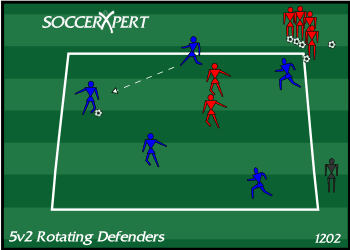
Five attackers keep the ball from a pair of defenders in a small grid — hit the target number of passes and the defenders do pushups, and every dead ball brings in a fresh pair.
Keeping possession is good passes and good passing decisions — plus moving to open space and communicating — and a 5v2 grid asks for all of it on every touch.
The weekly budget is the part coaches miss. A coach who runs heading twice in a week is not being reckless, they are unaware there is a cumulative cap at all — say the cap, then trust the trained adult: about 30 minutes and 15-20 headers per player per week, everything counted, including games.
Starting at Core — your team is set to mixed.
15 min tonight · 5 attackers vs rotating pairs (5v2)
- Ages 8+
- 5 attackers vs rotating pairs (5v2)
- 15 min as the drill is written
- Cones, pinnies, balls
Grab Cones, pinnies for the five attackers, and the ball supply.
Build Build a grid about 15 by 15 yards.
Place Five attackers in pinnies inside the grid; everyone else pairs up behind one corner cone with the supply of balls.
- 1
Organize the players
Put the five attackers in pinnies inside the grid and pair the rest up as defenders behind one corner cone with the balls. Pick the pass count the attackers are chasing — the number is yours to set.
“Five inside, pairs at that corner. Attackers — I'll give you a number; that many passes in a row and the defenders owe you pushups.”
- 2
Show the jobs
Walk one round — the first pair passes a ball into the five attackers and immediately steps into the grid to defend, making it 5v2. The attackers keep passing until they hit the number — pushups for the defenders — and the round runs until the defenders win the ball or it's knocked out of play.
“Defenders — pass it in, then go get it. Attackers — hit the number and they're doing pushups.”
- 3
Play
Run round after round — the moment a ball is dead, the next pair plays into the same five attackers and play resumes. Watch the decisions — good passes to feet, a first touch toward space, and making the play easy.
“Move! Find the open space — make the next pass easy!”
Look for Speed of play — quick decisions, passes to feet, and a first touch that already points toward space.
- 4
Switch and repeat
Keep the pairs cycling through. For a twist, introduce splits — a pass that splits the two defenders costs them 10 pushups.
“New rule — split the defenders and that's ten pushups, right there!”
If the attackers can never string passes together, widen the grid while they play — a larger grid is easier for the attackers and harder for the defenders — then bring it back in.
Go deeper · 2 notes
Why it works
Two defenders against five makes possession possible but never free — keeping the ball takes good passes, good decisions, movement to open space, and communication — and the pushup stakes plus a fresh pair on every dead ball keep the pressure coming.
What they learn
Keeping possession — good passes to feet, good passing decisions, a first touch toward space, moving to open space, communication, and speed of play.
Where does this come from?
SoccerXpert — their published drill library.
A published drill library. Useful and widely used, but not a governing body — so it fills gaps rather than leading.