Check-in Passing Warm-up
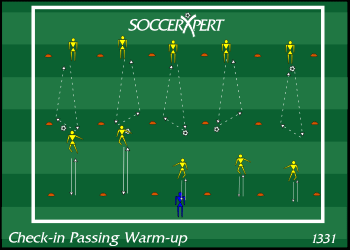
Your partner plays in, you check in hard to the middle cone, strike the return pass, and backpedal to your line — ten times, then you switch.
Checking in to meet a pass is its own skill — this warm-up works the timing and the striking of a ball while you're moving to it.
10 min tonight · Pairs, one ball
- Ages 9+
- Pairs, one ball
- 10 min as the drill is written
- Cones, balls
Grab Cones for three lines and a ball for every pair.
Build Build three lines of cones spaced 5 yards apart, with the cones lined up straight across the three lines.
Place Each pair takes its cones — both players starting on the outside lines, the ball with the non-working player.
- 1
Organize the players
Divide the team into pairs with one ball per pair, and start both players on the outside lines — one working, one playing the ball in.
“Partners — outside lines, one ball. Decide who's working first.”
- 2
Show the jobs
Walk one rep — the non-working player passes the ball in; the working player checks in toward the middle cone, receives the ball just outside it, plays it back to their partner, then backpedals to the outside line where they began. Ten reps, then switch.
“Check in hard to the middle cone, meet it just outside, play it back — then backpedal home and go again. Ten of those, then trade.”
- 3
Play
Call how the touch is received and cycle the patterns — inside of the foot across the body with the pass off the inside of the opposite foot; outside of the foot to the outside of the same foot with the return off the inside; one-touch with the inside of the foot alternating right and left; one-touch with the outside of the foot alternating right and left. Watch the surface details — toe slightly lifted and heel down on inside-of-the-foot receptions, toe turned in toward the plant foot on the outside.
“Inside of the foot this round — toe up, heel down! Meet the ball, don't wait for it!”
Look for The check-in and the pass arriving together — the ball received just outside the middle cone with the proper surface of the foot.
- 4
Switch and repeat
After each set of ten, the partners switch. For later rounds, add other receiving patterns — inside of the foot to the outside of the same foot, a trap with the outside returned with the inside of the same foot, and so on — or have the players pick the ball up and work on taking touches out of the air.
“Trade jobs! And this set we're taking it out of the air — pick it up and serve.”
If the run and the pass never arrive together, freeze it and ask — when should the check-in start? Let them answer, then play on.
Go deeper · 2 notes
Why it works
Checking in to a pass puts timing inside every touch — the receiver has to arrive, receive with the right surface, strike the return, and reset with a backpedal before the next ball.
What they learn
Timing and striking a ball while checking in to a pass — receiving with the inside and outside of the foot, one-touch play off both feet, and the surface details of toe lifted with heel down on the inside and toe turned in toward the plant foot on the outside.
Where does this come from?
SoccerXpert — their published drill library.
A published drill library. Useful and widely used, but not a governing body — so it fills gaps rather than leading.