Crossing and Finishing
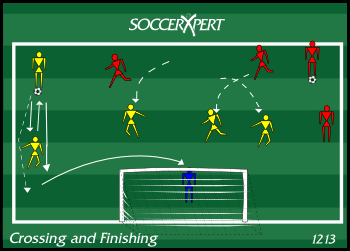
Wide players work a 1-2, race onto their own ball in the corner, and cross for three lines of runners attacking their assigned spots on goal.
Crossing, shooting, and heading — the whole attacking pattern inside the 18-yard box, from the wide 1-2 to the finish.
The weekly budget is the part coaches miss. A coach who runs heading twice in a week is not being reckless, they are unaware there is a cumulative cap at all — say the cap, then trust the trained adult: about 30 minutes and 15-20 headers per player per week, everything counted, including games.
15 min tonight · Five lines — 2 crossing, 3 attacking
- Ages 9+
- Five lines — 2 crossing, 3 attacking
- 15 min as the drill is written
- Cones, balls, full-size goal
Grab Cones for the five lines, balls, and your full-size goal.
Build Set five lines across the field about 5 yards above the penalty area.
Place Crossing players in the two outside lines, attackers in the middle three, and the keeper in goal.
- 1
Organize the players
Set the five lines — crossing players on the two outside lines, attacking players in the middle three — and put the keeper in goal. Give each middle line a particular area of the goal to attack — near post, back post, and one more of your choosing.
“Wide lines, you're crossing. Middle lines — you each own a spot on that goal. Know yours.”
- 2
Show the jobs
Walk the pattern on one side — the first player in the crossing line steps out in front, facing the line, as the passer; the next player is the crosser. The crosser passes to the passer, takes the return, plays a ball past the passer into the corner for themselves, sprints past the passer onto it, and crosses for the middle players running in. The crosser then becomes the passer, and play repeats.
“Pass, take it back, play it past them into the corner, sprint on — and cross for the runners.”
- 3
Play
Run it live, alternating crosses from the right and the left sides. Watch the crossers' body position — hips facing the middle of the field — and the finishers staying composed, looking to redirect the ball past the keeper.
“Time your run — arrive with the ball, not before it!”
Look for Runs timed to the cross — attackers arriving as the ball does, not getting in too quick or too slow.
- 4
Switch and repeat
Keep the rotation moving — every crosser becomes the next passer. For later rounds, play one-touch on every ball, add defenders in the middle for pressure, call the finish — headers or volleys — or ask the crossers to drive their balls low, or drive them in hard.
“Next round I call the finish — headers only. Crossers, put it where your runners live.”
If the runs and crosses never meet, freeze it and ask — when does your run start? Let them answer, then play on.
Go deeper · 2 notes
Why it works
One repeating loop — pass, return, self-played ball into the corner, sprint, cross — feeds a stream of real crosses to runners who each know exactly which part of the goal they are attacking.
What they learn
Crossing, shooting, and heading in the 18-yard box — crossers getting their hips facing the middle of the field, attackers timing their runs, and finishers staying composed and redirecting the ball past the keeper.
Where does this come from?
SoccerXpert — their published drill library.
A published drill library. Useful and widely used, but not a governing body — so it fills gaps rather than leading.