First Defender, No Opposition
Defenders learn the first-defender approach — fast, controlled, body between ball and goal — before anyone tries to beat them.
Pressure is a skill before it is a duel: approach speed, posture, and position have to be habits before a live attacker tests them.
15 min tonight · Two lines of defenders, two attackers
- Ages 8–14
- Two lines of defenders, two attackers
- 15 min as the drill is written
- Cones, pinnies, balls, a full-size goal
Grab Pinnies and a few balls, and use a full-size goal — the goal is the point of reference.
Build Nothing to build — use the attacking third of the field in front of the goal.
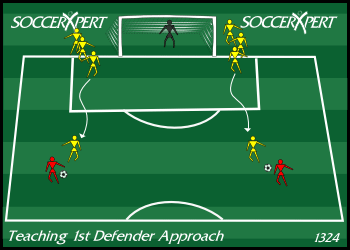
Place Two lines of defenders start beside the goal. Two attackers with a ball stand outside the penalty area, one on each side.
- 1
Organize the players
Set the two defender lines beside the goal and park an attacker with a ball on each side, outside the penalty area.
“Two lines by the goal. Attackers, hold your ball out wide.”
- 2
Show the jobs
Demonstrate one approach — sprint out fast, slow up before arriving, finish between the ball and the middle of the goal.
“Sprint, then slow up. Stay between the ball and the middle of the goal.”
- 3
Play
Call each pair out. Nobody tries to win the ball — the rep is the approach, the posture, and the position. Four or five reps each.
“Go! Fast... now slow. Hands up, eyes on the ball.”
Look for The slow-up before arrival — a defender still sprinting at the attacker is a beaten defender.
- 4
Switch and repeat
Rotate the lines. Then run the variation — the defender starts with the ball, serves the pass to the attacker, and goes.
“Next two! This round you serve the pass first — then close it down.”
Freeze one rep and shape the stance — knees bent, weight forward, hips turned, eyes on the ball — then run it again at speed.
Go deeper · 3 notes
Why it works
Whoever is closest to the ball is the first defender, so every player wears this job on Saturday. Taking the duel away isolates the approach, and the goal behind makes "between the ball and the goal" something they can see, not a phrase.
What they learn
The first defender's approach — closing speed, defensive posture, and position between ball and goal.
What's next
1v1 Defending the Dribble — the same posture, now against a live attacker.
Where does this come from?
SoccerXpert — their published drill library.
A published drill library. Useful and widely used, but not a governing body — so it fills gaps rather than leading.