Trapping with Passive Opposition
A server plays balls in — to chest, thigh, or feet, your call — while a defender stands close enough to touch the receiver and tries to break their focus.
A defender close enough to touch you changes everything — the receiver learns to trap and control the ball while staying aware of their surroundings.
Starting at Core — your team is set to mixed.
15 min tonight · Groups of 3 — server, receiver, defender
- Ages 8+
- Groups of 3 — server, receiver, defender
- 15 min as the drill is written
- Balls
Grab A ball for every group of three.
Build Give each trio its own space, with the server starting 10 yards from the receiver and defender.
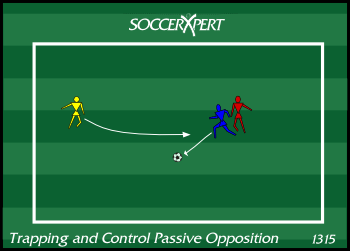
Place One server with the ball, one receiver working on control and trapping, and one passive defender standing close enough to touch the receiver.
- 1
Organize the players
Set up groups of three and assign the jobs — a server, a receiver working on control and trapping, and a passive defender. The server starts 10 yards away.
“Threes — one serving, one receiving, one shadowing. Server, ten big steps back.”
- 2
Show the jobs
Walk the round — the server plays a ball into the receiver, to the chest, thigh, or feet as you specify. Serves to the chest and thigh are thrown underhanded; serves to the feet are played with the feet. The defender stands close enough to touch the receiver and tries to distract them, but does not try to win the ball. Once the ball is trapped and under control, the receiver plays it back to the server and repeats.
“Defender — close enough to touch, be annoying, but you're not stealing it. Receiver — trap it, own it, play it back.”
- 3
Play
Call the serving surface and review the trapping techniques as they work — trapping with the chest, the thigh, the inside of the foot, the outside of the foot, the instep, and the sole of the foot.
“Chest serves this round! Trap it soft and get it down — the defender is just noise.”
Look for Control under distraction — a trap that settles the ball even with the defender crowding the receiver's space.
- 4
Switch and repeat
Repeat and work through the serves — chest, thigh, feet. When the traps are clean, allow the defender to apply minimal pressure, and increase the defensive pressure from there.
“New round — defender, you can lean in a little now. Receivers, same clean trap.”
If the traps fall apart, take the defender back to distraction only — no pressure — until the control returns, then build it back up.
Go deeper · 2 notes
Why it works
The passive defender is the whole point — close enough to touch, distracting but never tackling — so the receiver builds trapping and control while learning to be more aware of their surroundings.
What they learn
Trapping and control under distraction — with the chest, the thigh, and the inside, outside, instep, and sole of the foot — plus awareness of your surroundings.
Where does this come from?
SoccerXpert — their published drill library.
A published drill library. Useful and widely used, but not a governing body — so it fills gaps rather than leading.