4v4 Soccer to a Small Gate
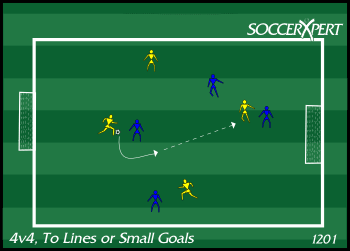
Two teams of four play the smallest version of the full game — each attacking a small gate on the other end line, where a goal is the ball stopped inside the gate.
4v4 is the smallest version of a full-sided match — every player attacks, defends, supports the ball, and spreads the field on every single play.
The weekly budget is the part coaches miss. A coach who runs heading twice in a week is not being reckless, they are unaware there is a cumulative cap at all — say the cap, then trust the trained adult: about 30 minutes and 15-20 headers per player per week, everything counted, including games.
20 min tonight · Two teams of 4 (4v4)
- Ages 4+
- Two teams of 4 (4v4)
- 20 min as the drill is written
- Cones, tall cones, pinnies, balls, practice sticks, Pugg goal
Grab Cones for the grid and gates, pinnies for one team, and balls.
Build Build a grid about 40 by 25 yards with a gate about 8 feet wide on each end line — and build extra fields if you have the players for it.
Place Two teams of four take the field, each with a gate to defend.
- 1
Organize the players
Divide the group into two teams of four and give each team a gate to defend. If you have more players, run a second field so everyone plays.
“Two teams of four. That gate is yours to defend — you're scoring in the far one.”
- 2
Show the jobs
Walk the scoring rule — a goal counts only when the ball is stopped inside the gate along the end line. The field is longer than it is wide on purpose; the shape emphasizes passing and puts a premium on playing the ball forward early.
“Stop the ball inside their gate — stopped on the line, not blasted through. And look forward early!”
- 3
Play
Let the game run — with numbers this small, nothing hides. On the attack, penetrate with the pass, dribble, or shot, support the ball, and use the whole width and length for supporting angles. On defense, pressure, cover, and balance, with as many players behind the ball as possible, and keep everyone talking.
“Heads up — keep that head on a pivot! Talk to each other!”
Look for Heads on a constant pivot — players looking up and reading the game before the ball reaches them.
- 4
Switch and repeat
When a team reaches 5 goals, switch out players or teams. For a different round, swap the gates for a cone-marked end line — a goal is the ball stopped anywhere along it.
“Five! New game — fresh players coming in.”
If the game isn't working for this group, resize the field while they play — the right size for their age and skill is what makes the workout effective.
Go deeper · 2 notes
Why it works
As the smallest version of a full-sided game, 4v4 asks every player for all of it — penetrate by pass, dribble, or shot, support the player with the ball, and create width on attack; pressure, cover, and balance on defense — with no position to disappear into.
What they learn
Attacking, defending, passing, receiving, supporting, penetrating, and spreading the field — with vision, communication, first touch, and changes of direction and speed throughout.
Where does this come from?
SoccerXpert — their published drill library.
A published drill library. Useful and widely used, but not a governing body — so it fills gaps rather than leading.